
Ecclesiology
Biblical Text
1. 1 Timothy 3:1-13 ESV – Apart from the Pastoral leadership in the Church, this scripture also emphasizes the need and existence of qualified Deacons and Overseers in the church. A clear indication of a church structure calls for other leaders who can benefit the church congregation.
2. Ephesians 4:11-13 – When Jesus Christ himself has laid the church structure that requires the apostles, the prophets, the evangelists, the pastors, and teachers, then every church member including the pastors must earnestly pray and look for spiritually qualified people who can serve these roles to bring full benefit to the church.
3. Acts 6:1-7 – We must publicly appoint qualified spirit-filled people in the church for different tasks. All those church movements that practice with no church government must learn that besides the pastors, the church still needs more qualified people in the church to serve.
4. Galatians 3:28-29 – According to this scripture, because of Christ Jesus, there are no more Jews or Gentiles, therefore, it would not be appropriate according to the New Testament scripture to distinguish the New Testament church from Israel.
5. Ephesians 2:11-22 – This biblical scripture is one of the most profound explanations of the Apostle Paul for the non-Jews receiving the spiritual citizenship of Israel through the blood of Jesus Christ.
6. Hebrews 12:22 – The writer of the Hebrews scripture speaks that the new Jerusalem is indeed located in heaven. Therefore, the concept of ethnic Israel reigning over the nation is not something that will happen on this earth during the millennium when Christ returns.
Key Issues: On the Doctrines of Ecclesiology
1. Nongovernmental Church: One of the issues in Ecclesiology that is most common is having no church structure government. Biblical theologians define it as a “Nongovernmental Church.” These types of church movements don’t follow the biblical ways of doing church. Particularly when it comes to organizing and delegating certain positions in the church. They just emphasize the role of a single Pastor (who planted the church) by relying on the inner voice or the leading of the Holy Spirit for the Church (which is not wrong). However, according to the New Testament Church of Christ, should function with a biblical form of church government that promotes elders, deacons, evangelists, and teachers. But somehow, the concept of the church government is completely missing because of ignorance and disobedience towards God’s word.
2. Dispensationalism:The other doctrinal error is the Theology of “Dispensationalism” because it makes a distinction between ethnic Israel and the New Testament church. They also believe that the futuristic hope given in the Old Testament scriptures can’t be completely fulfilled with the New Testament church because it is not ethnic Israel. They believe that all the prophecies in the Old Testament scriptures concerning Israel are supposed to be taken literally by rejecting the idea of Israel as the New Testament church. Therefore, they believe in the literal restoration of ethnic Israel through Christ Jesus. With that, they see Isaiah 2:2-4 in the light of ethnic Israel having a task related to Nations when Christ return, and rules on the Nations in the millennial period on this earth.
Personal Statement
1. Nongovernmental Church: It is biblically evident that we must have a church government structure to fully benefit the church. Having no church government will not help the congregation to grow mature in Christ. Every person has different giftings, therefore, responsibilities should be delegated accordingly to use individual giftings to benefit the whole congregation.
2. Dispensationalism: It is not biblically evident to support the theology of “Dispensationalism” because in Christ, we are all spiritually Abraham’s seed and for that reason all Christ believers will inherit every promise given by God in the New Heaven and New Earth.
Warrant for Position
1. Nongovernmental Church: According to the New Testament scriptures, the church needs to have different authorities with different roles and responsibilities assigned to the faithful congregation. It’s not just the church pastor who should rely on himself to form a church government. Biblically, it is very clear that we must have a Church government that should consist of apostles, prophets, evangelists, pastors, and teachers who can equip the body of Christ (Eph 4:11-12). A qualified spiritual team that will be united in leading and helping the congregation to attain the whole measure of the fullness of Christ (Eph 4:13). According to 1 Timothy 3:1-13, the church should also look for overseers, elders, and deacons in the church structure. Making sure that these leaders are selected according to biblical standards. We may also investigate Acts 6:1-7, where we note seven qualified men (including Stephen) being selected and given the responsibility for a certain task by the Church leaders. These men were not selected to teach the Word of God, but instead, they were chosen to help the widows. For that reason, the other ministers were able to pray and preach the word without any other distraction (Acts 6:4). In a similar way, some independent churches would need to learn to appoint qualified individuals with different responsibilities in the church. Those responsibilities shouldn’t be delegated or given to an individual without involving the church leaders or the congregation. Like Acts 6, the leaders must appoint a person with a certain role in front of the church congregation. Sometimes, the leader of the church (mostly pastors) gives the responsibility not in a biblically organized way. They delegate a person with certain responsibilities without involving the congregation. Therefore, no one in the congregation would know when he/she was given some responsibility in the church by the leaders. Hence, when the congregation sees those people operating without being appointed in front of the congregation, then the congregation ends up ignoring, disrespecting, and rejecting their responsibility or role in the church.
It is also biblically important to work as a team to bring full benefits to the church in many ways. Somehow, the pastors purposely don’t want to appoint someone in the congregation because they want to see themselves as a superior authority in the church. Therefore, these pastors (who may have planted their church) neglect the church government so that they can have strong control. However, in this way, I have seen that the church will eventually never do well. On the other hand, it is also important to address that when a pastor delegates a certain responsibility that may require the role of a teacher or an elder, then that person must practice submission under the leadership of the church. In some cases, when a pastor delegates responsibility to a certain person, then that person sometimes ends up being deceived by taking control of the congregation with the wrong motivation of splitting the church congregation and making it his own. This problem has occurred in the past frequently; for that reason, somehow, the pastors don’t feel comfortable appointing or giving a certain leadership role to someone in the church. However, the church leadership should still aim with wisdom and sensitivity to have a church government. They must often teach unity, submission, team building, and discipleship, and should not be afraid of what others may end up doing. Because, as God’s servant, the primary call is to faithfully serve with biblical standards. So there is a need to learn to submit to God’s call on the church Government despite the challenges and obstacles they might need to face.
2. Dispensationalism: The theology of Dispensationalism should not be taken seriously as it promotes a literal understanding of the prophecies in the scriptures being fulfilled for ethnic Israel when Christ returns. Biblically, it is evident that the concept of Israel being special in God’s eyes has been changed in the New Testament scriptures. Now, all those who believe in Christ are the new spiritual Israel. One of my favourite scriptures to defend my case is from Galatians 3:28-29. It reveals the concept of ethnic Israel being no more valid: “There is neither Jew nor Gentile…if you believe in Christ, then you are Abraham’s seed, and heirs according to the promise.” In Ephesians 2:14, Paul makes it clear that God in Christ has destroyed all the barriers and has made two groups into one. Therefore, Jesus’ followers are the citizens of God’s kingdom, which is spiritual Israel ( Eph 2:11-22). First Peter 2:9 calls believers a holy nation. Additionally, the new city of Jerusalem, according to Hebrews 12:22, should be seen as the new Earth and new Heavenly Jerusalem: “But you have come to Mount Zion and the city of the living God, the heavenly Jerusalem, and innumerable angels in festal gathering.” Therefore, the concept of ethnic Israel, reigning over the nation, is not something that will happen on this earth during the millennium when Christ returns.
Soteriology
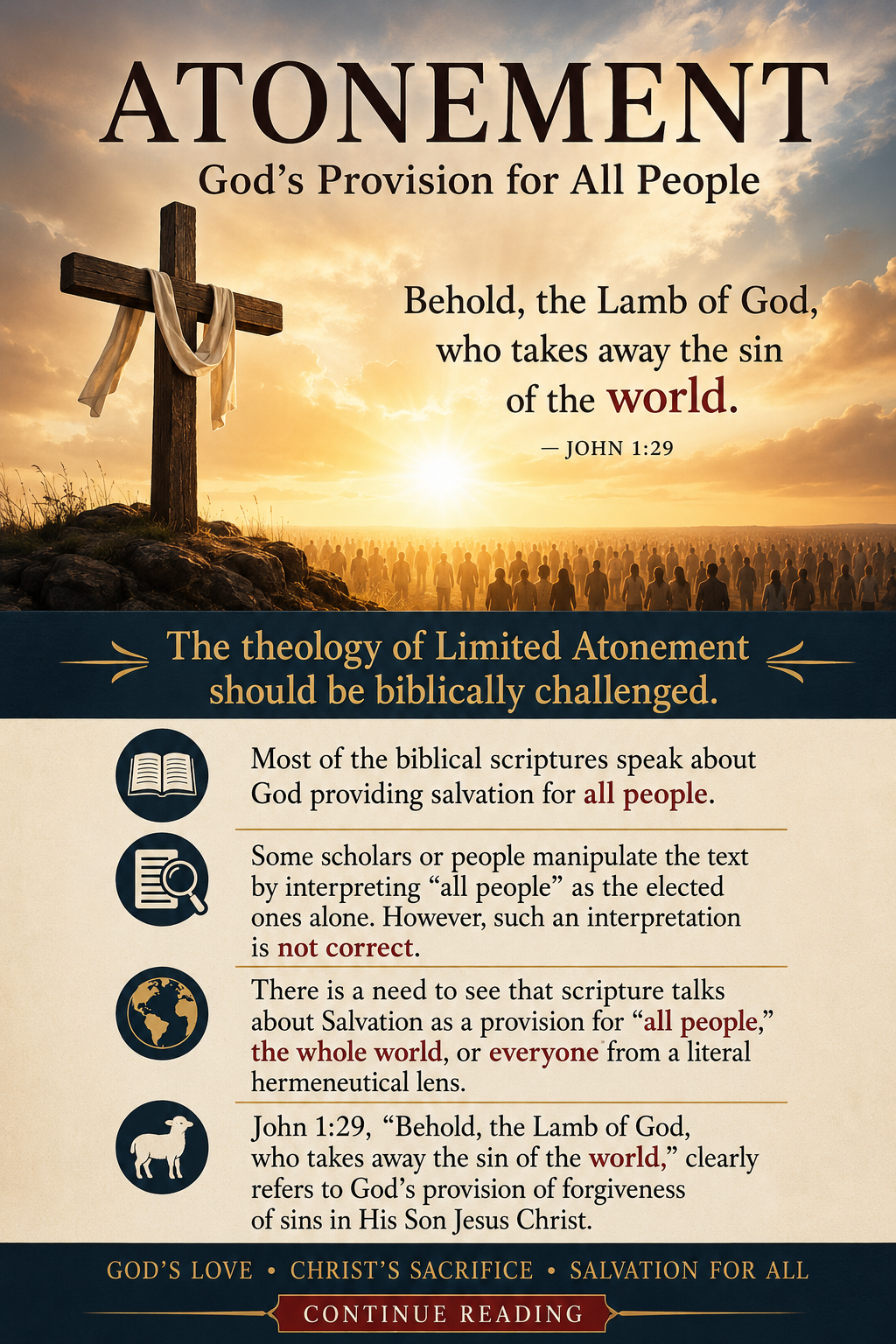
Jesus’ crucifixion should be biblically concluded as a propitiation for the whole world without exception. Thus, the doctrine of Limited Atonement should be considered incompatible with Jesus Christ's free offer for all humanity to be saved by believing in Jesus Christ as their Lord and Savior of the world. The Gospel that leads to salvation should be understood as Unlimited Atonement, an offer of salvation for all humanity.
Biblical Text
1. John 1:29 ESV– Jesus’ sacrificial offering of his body as a perfect lamb sacrifice is indeed an offer for redemption and deliverance for everyone in the World.
2. John 3:16—The passage reveals that God, in His love for the whole world, gave His only son Jesus Christ to die and become the ransom and redemption for all those who would believe in Jesus’ perfect sacrifice on the cross for the forgiveness of their sins.
3. 1 John 2:1-2—The Apostle John makes it clear that Jesus’ death on the cross was not just for the elect, but Jesus indeed died for the sins of the whole world. However, this may not mean that everyone in the world will be saved (Universalism). Some will still reject this gracious offer of salvation by rejecting God’s exclusive way of providing eternal life in Christ Jesus alone.
4. Titus 2:11– The Salvation plan of God is offered to all sinful people. It is not just a few people who will respond to the call of Salvation.
5. Romans 10:9– Confessing and believing in the resurrected Jesus Christ as the Lord and Savior is the most foundational declaration for salvation. This confession seals the belief in the heart.
6. Hebrews 10:29 – God’s offer for salvation is for everyone in the world, however, some people will still deny and reject that grace and eventually bear the consequences of God’s denial of them.
7. Mark 10:45 - Jesus’ sacrifice was not a ransom to the enemy, but indeed it was offered to God.
8. Romans 5:9– Jesus’ crucifixion satisfied the righteous wrath of God against all the repented sinners. Exactly as we often sing the song - In Christ Alone- “Till on that cross as Jesus died, the wrath of God was satisfied.” [1]
Key Issues: On the Doctrine of Soteriology
1. Limited Atonement: The doctrine of Limited Atonement is especially connected with the Reformers particularly with those who promote the five points of Calvinism, “TULIP.” The “L” in Tulip of Calvinism stands for the doctrine of Limited Atonement, which promotes that God ordained or planned Salvation through Christ for the elect alone. They wrongly conclude in the theology of Limited Atonement that Jesus Christ died only for His chosen people. The sheep that will hear Jesus’ voice (John 10:4). According to R.C Sproul, Limited Atonement, theology means that Salvation was an eternal plan of God to save or redeem specific sinners. [2] Therefore, according to the Limited Atonement doctrine, people would see Jesus’ crucifixion as a perfect plan of God to save only His chosen people through Jesus, who will lead only the elect to accept Salvation without failing. On the other hand, this means that Jesus' sacrifice on the cross is limited to the elect alone, therefore, no sacrifice is available for the reprobate who are not elected. Somehow, the Limited Atonement promotes that God chooses some to be saved and others who are not saved to be dammed for eternal destruction. Therefore, for that reason, the wrong doctrine of the Limited Atonement should be biblically challenged.
2. Ransom Theory of Atonement: The other key issue related to Soteriology is the Ransom Theory of Atonement. It was mainly popular between the 4th and 11th centuries, promoted particularly in the works of Origen of Alexandria. The theory promotes that the death of Jesus Christ is a ransom given to Satan to set sinful human beings free. This view is often supported by Mark 10:45, however, the scripture does not mention anywhere that the ransom price was paid to Satan. Therefore, there is a clear error in this theory that should also be biblically challenged.
Personal Position
1. Limited Atonement: Jesus’ crucifixion should be biblically concluded as a propitiation for the whole world without exception. Thus, the doctrine of Limited Atonement should be considered incompatible with Jesus Christ's free offer for all humanity to be saved by believing in Jesus Christ as their Lord and Savior of the world. The Gospel that leads to salvation should be understood as Unlimited Atonement, an offer of salvation for all humanity.
2. Ransom Theory of Atonement: On the other hand, the Ransom Theory of Atonement also has an error. The price paid on the cross to set the sinners free from bondage was to God the Father. Not to Satan. Men and women never sinned against Satan but against God. Therefore, Jesus’ sacrifice on the cross satisfied the wrath of God against all those who will repent and believe in Christ.
Warrant for Position
1. Limited Atonement: The theology of Limited Atonement should be biblically challenged. Because most of the biblical scriptures speak about God’s offer of Salvation for all people. Some scholars or people end up manipulating the text by interpreting “all people” as the elected ones alone. However, such an interpretation is not correct. Therefore, there is a need to see that scripture talks about Salvation as an offer for “all people,” for the whole world, or everyone from a literal hermeneutical lens. Exemplar is John 1:29, “Behold, the Lamb of God, who takes away the sin of the world,” clearly refers to God’s offer of forgiveness of sins in His Son Jesus Christ. Alongside this, even 1 John 2:2 is also clearly speaking about Jesus being the propitiation for “not just for our sins, but also for the sins of the whole world.” Apostle John particularly adds here that the atoning sacrifice of Jesus is “not for just the believers” but also the “whole world.” The “whole world” refers to the unbelieving, sinful world. [3] However, we must know according to the biblical scriptures that believing and confessing Christ Jesus as Lord and Savior is essential for salvation “Believe in the Lord Jesus, and you will be saved, you and your household” (Acts 16:31), “For I am not ashamed of the gospel, for it is the power of God for salvation to everyone who believes, to the Jew first and also to the Greek” (Rom 1:16), “If you confess with your mouth that Jesus is Lord and believe in your heart that God raised him from the dead, you will be saved” (Rom10:19).
Therefore, it is important to note that only one thing can hinder someone from receiving salvation. It would be their negative response towards the offer of grace in Christ Jesus that leads to eternal life. In Hebrews 10:29, we can note that some people will reject the New Blood Covenant of Jesus Christ that offers grace unto Salvation. Therefore, from this scripture, we understand that even those who are offered God’s grace through Jesus Christ can somehow reject the grace offered. And not only that they will just reject God’s grace, but in the New Covenant, compared with the Old Covenant, such people will suffer greater consequences for rejecting the grace of God. Therefore, from this part of scripture, we can counterfeit the doctrine of Limited Atonement, which claims that Jesus’ offer of grace is only for those who will respond to the atoning sacrifice of Jesus Christ. Thus, the concept of Definite Atonement is biblically incorrect because some people can still reject the grace offered to them. On the other hand, biblically we can conclude that the Atoning sacrifice of Jesus Christ is not limited. Jesus' sacrifice was made for the forgiveness of sin for the whole world. However, to receive this offer, one must respond with confession and faith in the Son of the living God, Christ Jesus, who died and was raised back to life.
2. Ransom Theory of Atonement: The other Atonement theory that has an error is the Ransom Theory of Atonement. No biblical scripture supports this theory at all. Mark 10:45, “The Son of Man came not to be served but to serve, and to give his life as a ransom for many”, has been used to promote the theory of Ransom to Satan. Scripture never speaks about Jesus paying a price to Satan. From the beginning, the first human beings Adam and Eve never sinned against Satan. Their sin and disobedience were against God’s law. And it is not just Adam and Eve, we all have sinned multiple times against God’s holistic ways of the law. Primarily, it was Satan himself, the father of lies and deception, who boldly disobeyed and rebelled against God’s ways. Therefore, how would Jesus’ sacrifice on the cross be understood as a ransom paid to Satan, who himself is an evil being? This theory is completely incorrect. It is biblically clear and evident that Jesus’ atoning sacrifice was made to please and satisfy the wrath of God against all ungodliness in the world. A few scriptures are cited here to support this view. Romans 5:9 “We have now been justified by his blood, much more shall we be saved by him from the wrath of God.”1 John 2:2 “He is the propitiation for our sins, and not for ours only but also for the sins of the whole world.” Therefore, it is clear that Christ's sacrificial offering was sacrificed to God as the substitutionary atonement in the place of all the sinners in the world who had sinned against God’s holiness. The ransom was paid to God so that all people may have the opportunity to respond with confession in Jesus Christ for Salvation and be set free from the condemnation of sin, which is eternal death.
Bibliography
Getty music. 2021. https://store.gettymusic.com/ca/song/in-christ-alone/ (accessed February 25, 2025).
Ligonier Ministries. 2021. https://www.ligonier.org/learn/series/what_is_reformed_theology/limited-atonement/ (accessed February 23, 2025).
Colin G. Kruse, The Letters of John. Edited by D.A. Carson. Grand Rapids, MI: William B. Eerdmans, 2000. 66
Christology From Above
One of the oldest false Christology theory is “Low Christology.” It is also known as the “Evolutionary Model.” Initially proposed by the Religionsgeschichtliche Schule, especially Wilhelm Boussets’ influential Kyrios Christos (1913). One of the New Testament textual criticism scholars, Bart Ehrman also supports this “Evolutionary model.” He explains that Jesus’ identity on earth began with a human Jesus who later became divine, and he explains that this would have happened after Jesus’ resurrection or during Jesus’ Baptism. Bart explains that “Jesus was understood to have been a human, a full flesh-and-blood man, who came to be exalted and glorified by God and so raised to the rank of the divine, therefore, the Christology begins among the humanity down here on the earth and is known as a Low Christology.” Bart Ehrman holds this view because he understands that Jesus never knew that he was more than a human being. Wolfhart Pannerberg in his book “Jesus God And Man” also holds the view of the “Evolutionary Model.”
Biblical Text
Philippians 2:6-11: An early Christian hymn and passage embraced and affirmed corporately and liturgically as a popular expression of devotion to Jesus as God.[1]
John 1:1-14: Highly Christological scripture that is indeed a classical formulation that begins from God and from Jesus, whose deity is already given, who is already God the Son, and who as the pre-existence Son of God as the eternal Logos, became a man (the human Jesus or the Jesus of history).[2]
Matthew 1:18-25 and Isaiah 7:14: The symbol of Christology from above is the virgin birth.[3]
Key Issues: On the Doctrine of Christology
Low Christology: One of the oldest false Christology theory is “Low Christology.” It is also known as the “Evolutionary Model.” Initially proposed by the Religionsgeschichtliche Schule, especially Wilhelm Boussets’ influential Kyrios Christos (1913).[4] One of the New Testament textual criticism scholars, Bart Ehrman also supports this “Evolutionary model.” He explains that Jesus’ identity on earth began with a human Jesus who later became divine, and he explains that this would have happened after Jesus’ resurrection or during Jesus’ Baptism. [5] With that, Bart explains that “Jesus was understood to have been a human, a full flesh-and-blood man, who came to be exalted and glorified by God and so raised to the rank of the divine, therefore, the Christology begins among the humanity down here on the earth and is known as a Low Christology.” [6] Bart Ehrman holds this view because he understands that Jesus never knew that he was more than a human being.[7] On the other hand, “Wolfhart Pannerberg” in his book “Jesus God And Man” also holds the view of the “Evolutionary Model.”[8]
Apollinarianism: Apollinaris, the bishop of Laodicea (A.D. 361) argued that Christ had a human body but not a human mind or spirit, and the mind and spirit of Christ were from the divine nature of the Son of God.[9] He affirmed that Christ Jesus possessed a “sensitive soul, but the word of God was in that soul in place of the intellect and the mind.”[10]
Personal Statement
Low Christology: From a Biblical perspective, I would clearly state that I believe in “High Christology”, and on the other hand, I would carefully conclude “low” Christology as heretical.
Apollinarianism: The doctrine of Apollinaris is biblically incorrect. Scriptures prove that Jesus took a human nature that was made of a body and soul with a clear human intellect and mind.
Warrant for Position
Low Christology: Jesus’ Supernatural birth serves as biblical evidence for a symbol for High Christology (Matt 1:20-23). Therefore, the theory of the Evolutionary Model that promotes “Low Christology” should be considered incorrect. We can also note the earliest reverence given to Jesus by the wise men who visited infant Jesus at his birth. When they saw Jesus, they “fell and worshipped him” (Matt 2:11). Alongside this, we note that even John the Baptist boldly declared about Jesus’ supremacy, “He who comes from above is above all” (Jn 3:31). Indeed, reflecting what Apostle Paul witness in Colossian 1:17 “And he (Jesus) is before all things.” On the other hand, John the Baptist was also aware of Jesus' purpose of taking away the sins of the World (Jn 1:29). Now if John knew about Jesus' identity and purpose, then why would not Jesus understand himself? Biblically we can argue that Jesus was aware of his divine identity and purpose and he knew it since his youth. We can note this from Luke 2:49 where Jesus said, “he had to be in his father's house.” Therefore, Bart Ehrman's statement about Jesus not understanding himself more than a human being before his baptism or resurrection is completely incorrect. On the other hand, we can support High Christology when we see Jesus publicly forgiving sins. Something that only God can do (Mk 2:5-7). And if we say that Jesus didn’t know that he was God, then why would Jesus being an agent of God’s Kingdom (which evolution theory agrees that Jesus only knew that was an agent of the Kingdom) publicly do such a scandalous act against God by forgiving someone’s sins? On the other hand, we can also note that Jesus was very much aware that He was God from the beginning because He said “Before Abraham was I am” (Jn 8:58). Therefore, it would be appropriate to say that Jesus didn’t become God as the Evolutionary Model would say. With that, one should always question why the Jewish religious leader crucified Jesus. What was Jesus’ fault? Was he a criminal? Biblical evidence is quite clear that Jesus was not a criminal. Roman Pontius Pilate declared Jesus' innocence three times (Lk 23:4,14, 22). Even Herod didn’t find any guilt in Jesus (Lk23:15). Therefore, we should note that Jesus was crucified because of the religious leaders who found Jesus’ statement and acts scandalous and blasphemy because they equalized Jesus with God (Mk 2:5-7, Matt12:8-14, Jn 8:58-59, Jn 10:3, Mk 14:62-64). Therefore, Jesus’ crucifixion makes it so clear that Jesus was crucified because he declared himself to be God. And it was not just Christ Jesus’ declaration because many others also witnessed Jesus’ divinity (Centurion at the cross (Mark 15:39), the Canaanite woman (Matt 15:22), Jesus’ triumphal entry (LK 19:38), blind Bartimaeus (MK10:47), Demons (Mk 5:7). Therefore, all this biblical evidence leads us to conclude that it was not possible that Jesus himself never knew he was God. It is strongly biblically evident that Jesus knew he was God because he fully played his divine role in his earthly ministry. Thus, I would conclude that biblically there is no room for such heretical “Low Christology.”
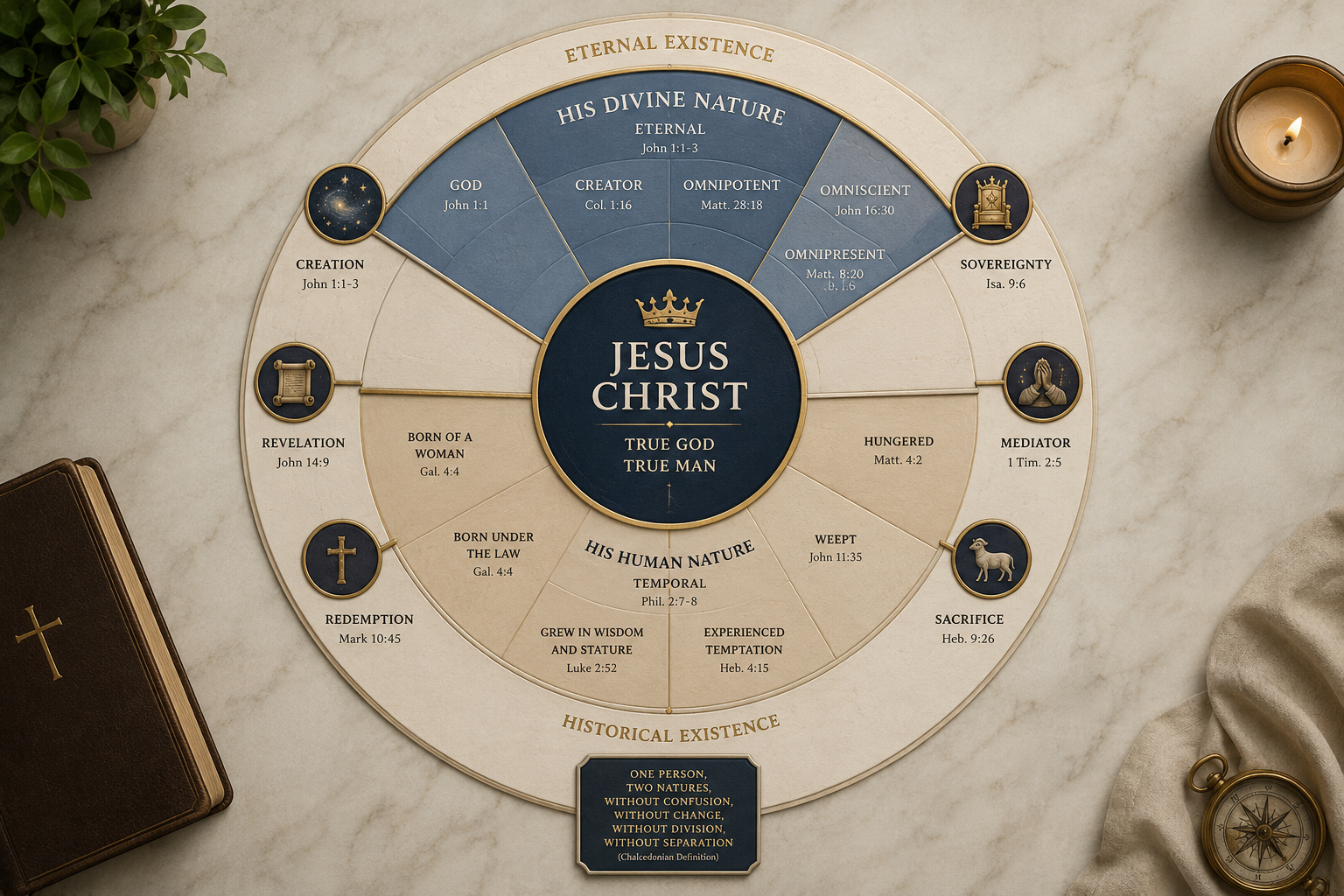
Apollinarianism: In defence of the doctrine of Apollinarianism, the Chalcedonian creed affirmed that Jesus had a rational body and soul. Even the church council of Alexandria in A.D. 363 and the church council of Constantinople in A.D. 381 rejected this view of Apollinaris.[11] Biblically we note that Jesus increased in wisdom and stature (Lk 2:52). Therefore, according to our biblical faith, we can defend that Jesus functioned with the human brain. However, it should be made clear that in Jesus’ divine nature, there was no growth since Jesus’ divine nature was perfect and complete from eternity. The other helpful biblical scripture that can help us understand Jesus’ human mind is Mark 13:32 “But concerning that day or that hour, no one knows, not even the angels in heaven, nor the Son, but only the Father.” Here Jesus acknowledges that as the “son of man” who has a human mind doesn’t know the hour. On the other hand, biblically we also understand that Jesus knows all things (John 16:30) therefore, we need to understand that for “this unique, two-nature, singular person of Christ, this is no contradiction, but a peculiar glory of God-man.” [12] Alongside this, it would also be important to highlight that Jesus is fully God. According to the historic Chalcedonian creed, Jesus Christ is one person who has two natures, divine and human. Indeed, the same perfect in Godhead and perfect in manhood; truly God and truly man. [13] We should know it’s not that Jesus Christ is 50% God and 50% man or 45% and 55%. It is biblically evident that Jesus is 100% God and 100% human. Therefore, even the other doctrines like Arianism (Jesus is not fully God) and Eutychianism (Jesus had only one nature after his incarnation) should be concluded heretical on the biblical evidence of Jesus’ full divinity and full humanity.
Bibliography
Larry W. Hurtado, How on Earth Did Jesus Become a God? Grand Rapids: William B. Eerdmans Publishing Company, 2005. 50
Robert L Reymond, Jesus Divine Messiah. New Jersey, Presbyterian and Reformed, 1990. 45
Donald Macleod, The Christology of Wolfhart Pannenberg. n.d. https://www.thegospelcoalition.org/themelios/article/the-christology-of-wolfhart-pannenberg/ (accessed February 2025).
Andrew Ter Ern Loke, The Origin of Divine Christology. Cambridge University Press, 2017. p3-4
Bart D. Ehrman, How Jesus Became God (The Exaltation of a Jewish Preacher from Galilee. HarperOne), 2014. 232
Bart Ehrman, The Earliest Christology. 13 February 2013. https://ehrmanblog.org/the-earliest-christology-for-members/ (accessed February 10, 2025).
Ibid.
Wolfhart Pannenberg, JESUS - GOD AND MAN. Philadelphia, Pennsylvania: The Westminster Press, 1968. 56
Wayne Gruden, Systematic Theology An Introduction to Biblical Doctrine. Grand Rapids, MI: Zondervan, 2000. 45
Christology from Nicea to Chalcedon: A Brief History. 6 March 2018. https://fromthestudy.com/2018/03/06/christology-from-the-nicea-to-chalcedon-a-brief-history/ (accessed February 27, 2025).
Wayne Gruden, Systematic Theology An Introduction to Biblical Doctrine. Grand Rapids, MI: Zondervan, 2000. 24
Jesus Is Fully Human. 15 December 2016. https://www.desiringgod.org/articles/jesus-is-fully-human (accessed February 27, 2025).
Ibid.